What a Missed Call Really Costs Your Business (Do the Math)

You were under a sink. Or on a roof in July. Or halfway through a color treatment with a client in the chair. The phone buzzed, you glanced at it, and you told yourself you'd call back in ten minutes.
An hour later you did. "Oh, thanks, we already found someone."
Ask almost any service business owner in Miami, and you'll hear a story like this. What almost nobody has is a number: how much revenue those calls might represent over a month or a year. This article is about getting to a realistic estimate, without the inflated figures you see in a lot of marketing.
How many calls do small businesses actually miss?
The most quoted figure comes from a 2016 study by 411 Locals, which monitored calls to 85 small businesses across 58 industries for 30 days. About 62% of the calls were not answered by a person: 37.8% went to voicemail and 24.3% got no response at all. Seven out of ten businesses in the sample answered fewer than half of their calls.
I want to be fair about that study. It is old and the sample is small, so treat it as a warning sign rather than a law of nature. PCN, an answering-service company, published a 2026 review that combines existing research with its own model calculations rather than new field data. It lands on a wider range: depending on staffing, peak hours and after-hours coverage, small and mid-sized businesses miss somewhere between 25% and 60% of inbound calls.
Either way, the honest answer is "more than you think." Most owners only remember the missed calls they noticed. The ones that rang while you were driving, or rang twice on a busy Saturday, or came in at 8 PM, mostly disappear without a trace.
Why calling back later isn't always enough
A missed call would be harmless if people simply tried again later, or picked up when you called back. Often, neither happens. There are two reasons.
People don't want to leave voicemail. Someone with a broken A/C or a leaking pipe wants a person, now. A greeting that says "leave a message and we'll get back to you" sounds like "maybe tomorrow." So they hang up and tap the next result on Google.
Your return call often goes unanswered, too. In Hiya's 2024 State of the Call report, 46% of calls from unidentified numbers went unanswered, even when a legitimate business was calling. Ninety-two percent of consumers said they believe unidentified calls are fraudulent, and 77% said they are more likely to answer when they know who is calling. So when you call back from a number they don't recognize, there's a real chance they let it ring.
The result can be a lead you already paid for (with ads, with your Google reviews, with years of reputation) that walks out the door before you even say hello.
The math: put your own number on it
Here is the simple formula. It's the same one most studies use, and you can do it on a napkin:
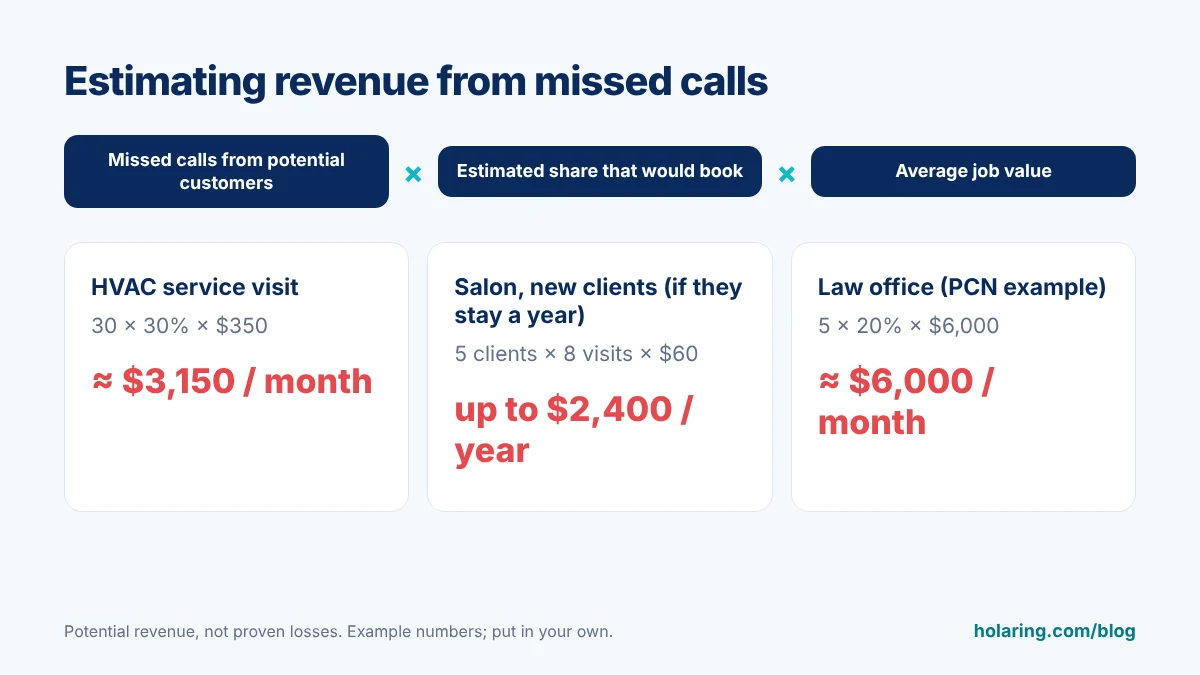
Missed calls from potential customers × estimated share that would have booked × average job value = estimated revenue at risk.
This is an estimate, not a measure of actual losses. Some missed calls are spam, repeat calls or existing customers. Some callers will try again, book online, or turn out not to be potential customers. And revenue is not profit. The real figure depends on how many calls came from new customers, how many you managed to win back, and how much work you could actually take on. Still, an honest estimate is far better than a guess. Let's take three examples with conservative numbers.
An HVAC company. In Housecall Pro's platform data, the average HVAC repair job reached $1,205 in 2025. That's an average across their customers, not a benchmark for every company. Let's be cautious and use a hypothetical $350 job value, well below that reported average. If the company misses 30 calls a month from potential customers and only 3 in 10 of those callers would have booked, that's 9 jobs × $350 = about $3,150 a month in potential revenue, or roughly $37,800 a year. If even a few of those were full repairs, the number gets much bigger.
A hair or nail salon. A single appointment might be $40 to $90, which doesn't sound like much. But a new client who likes you comes back every four to six weeks. Say you miss 10 calls a month from new clients and half of them would have booked. In a scenario where those five clients stay with you all year, at $60 a visit and eight visits each, that's up to $2,400 in potential revenue from repeat visits over a year, from just one month of missed calls. Not every new client stays, of course, but the point stands: a missed first call can cost you more than one appointment.
A small law office. In PCN's example calculation, one retained matter is assumed to be worth $6,000. Even if you miss just 5 potential new-client calls a month and only one of them would have hired you, that's about $6,000 a month in potential revenue. For a law firm, even one missed potential client can mean significant revenue that never arrives.
Your numbers will be different. The point is not to scare you with a big total. The point is to replace "I miss a few calls" with an actual figure you can compare against the cost of fixing it.
Where the calls slip through
When I talk to owners about when their calls get missed, the same situations come up again and again:
- During the job. You can't answer with gloves on, on a ladder, or with a client in front of you.
- After hours. Evenings and weekends are when people are home and notice problems. That's exactly when nobody is at the desk.
- The busy hour. Two calls at once, and the second one goes to voicemail. On the first hot day of the year, that can be most of your calls.
- Lunch and errands. Twenty minutes away from the phone is enough.
- The language gap. This one is very Miami.
The Miami factor: what language does your caller speak?
According to Miami-Dade County's own budget documents, more than 75% of residents speak a language other than English at home. Many of your callers will happily switch to English, but some won't, and many more will simply feel more comfortable with the business that answers in Spanish (or, in Sunny Isles and Aventura, in Russian).
If your front desk only speaks English, a share of your calls is "answered" but still lost. The caller hangs up politely and calls someone who speaks their language. That never shows up in your missed-call log, but it costs the same.
An honest check: not every business needs help
I'll tell you about a conversation I had recently. I visited a skin care studio and talked to the owner about missed calls. She has a woman at the front desk, three phones, and most of her clients don't call at all. They text and message on Instagram. She was polite, and she was right: phone answering wasn't her problem. Her problem, if she has one, is replying to messages.
Another owner, a hairdresser who works alone, told me it's simply more convenient for her to answer every call herself. That's a valid choice too.
So before you buy anything, check whether calls are really where your money leaks. If most of your customers book online or message you, fix that first.
How to fix missed calls (the real options)
If the math above made you uncomfortable, here are the realistic options, from cheapest to most complete:
- Call back faster, from a number people know. Save your business number with a clear caller ID name, and call back within five minutes. Free, but it only works when you're free.
- Forward to someone else when you're busy. A family member or a staff member. It works until they're busy too.
- A traditional answering service. A live person answers, usually priced per minute or per call. What they can do depends on the service: some only take messages, while others, like Ruby, also book appointments and answer common questions.
- An AI receptionist. Can take forwarded calls around the clock, including when your staff is busy or the office is closed, in several languages. It answers common questions, takes the details, books appointments, and sends you a summary. The tradeoff: it needs a good setup with your real information, and some callers will still ask for a person, so you need a rule for that.
Many businesses mix these: they answer themselves during the day and let an assistant (human or AI) take the calls they can't get to, after a few rings or after hours.
Do a 7-day missed-call check
You don't need any software to see your real picture. For one week, write down every evening:
- All incoming calls for the day.
- Missed calls, and when each one came: during a job, after hours, or while you were on another call.
- Spam and robocalls among them, so you can set those aside.
- Calls you won back: you called back and reached the person, or they called again.
- Jobs that actually came from those won-back calls.
At the end of the week, you'll see what share of real calls goes unanswered and how many you manage to recover. Then use the formula above with two or three scenarios (say, 20%, 30% and 40% of missed callers booking) to see the range of revenue you may be missing.
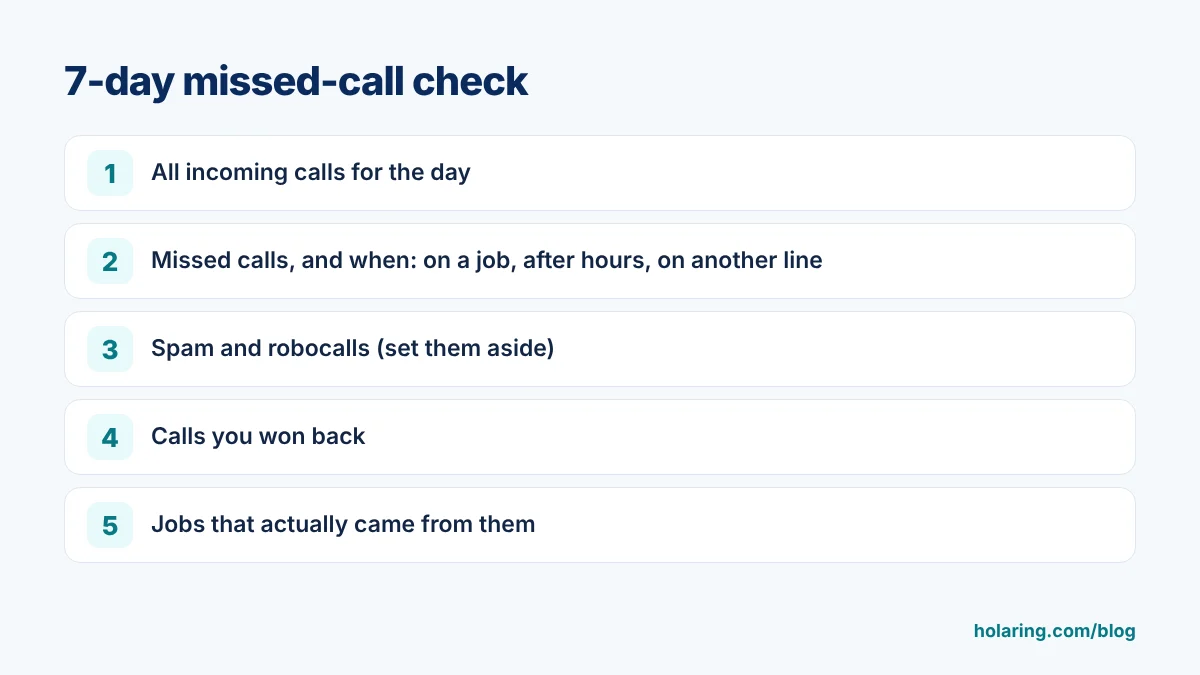
After a week, you'll have your first real picture: how many calls go unanswered, at what hours it happens, and how many of those contacts you manage to win back. That tells you which hours to cover first.
Curious how an AI receptionist would handle calls for your business? Try our live demo: leave your details here, get the demo number, and hear it for yourself. Boris will follow up within one business day to answer your questions. No obligation.
Sources
Hear an AI receptionist answer calls for a business like yours
Leave your details in a 30-second form and you'll get a number to call it yourself.
Try it